
Early Life and Education
Stewart Farrar, a luminary in the world of modern witchcraft, was born on June 28, 1916, in Highams Park, Walthamstow, London. Raised in a middle-class Christian Scientist household, Farrar’s early life was shaped by the contrasting influences of his father, a bank official, and his mother, a schoolteacher. His journey into the realm of journalism began at the City of London School for Boys, which led him to University College London. There, he honed his skills, eventually graduating with a degree in journalism in 1937. During his university years, Farrar took on leadership roles, serving as President of the London University Journalism Union and Editor of the London Union Magazine.
Military Service and Post-War Career
When World War II erupted in 1939, Farrar enlisted in the Army, where he served with distinction. As a Captain, he was tasked with writing the instruction manual for the 40mm Bofors gun, marking his first foray into serious writing. By the end of the war, he had attained the rank of Major and chose to remain in Germany as a civilian with the Allied Control Commission. His experiences in post-war Germany, including being one of the first British officers to enter Auschwitz, profoundly impacted his personal and political beliefs.
Upon returning to England in 1947, Farrar resumed his journalism career, eventually working for Reuters in London by 1953. His political journey took a significant turn in 1954 when he joined the British Communist Party and became the editor of the Daily Worker. However, the Hungarian uprisings disillusioned him, leading to his departure from the party.
Transition to Writing and Witchcraft
Farrar’s career took a creative turn as he ventured into scriptwriting for television and radio, contributing to the BBC and other media outlets. His work included the award-winning radio play ‘Watch the Wall My Darling’ and a children’s TV series ‘The Boy Merlin’. In 1958, he published his first fiction novel, ‘The Snake on 99’, followed by other detective thrillers and romance novels under the pen name Laurie Stewart.
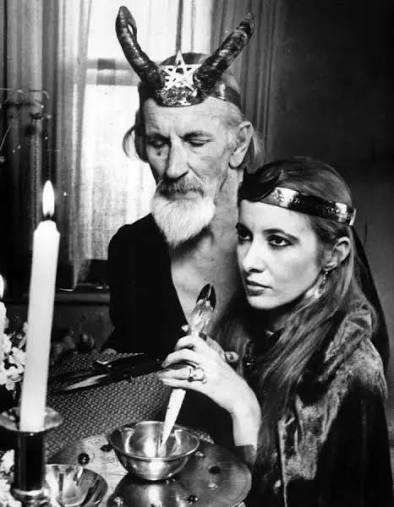
The pivotal moment in Farrar’s life came in 1969 when he was assigned to interview Alex Sanders, the self-proclaimed ‘King of the Witches’. This encounter sparked a deep interest in witchcraft, leading to his initiation into the craft by Sanders’ wife, Maxine, in 1970. This initiation was the foundation for Farrar’s exploration and eventual mastery of modern witchcraft.
Rise as a Leading Voice in Witchcraft
Stewart Farrar’s immersion into the world of witchcraft culminated in the publication of ‘What Witches Do’ in 1971, a book that established him as a key figure in the Wiccan community. Despite its controversial elements, the book was pivotal in demystifying modern witchcraft for a broader audience. Farrar’s relationship with Janet Owen, whom he met during his training, blossomed into a personal and professional partnership. Together, they founded their own coven and developed unique rituals and training methods, distancing themselves from the Sanders’ teachings.
The couple’s move to Ireland in 1976 marked a new chapter, where they continued to write influential books on witchcraft. Their works, such as ‘Eight Sabbats for Witches’ and ‘The Witches’ Way’, became cornerstones of Wiccan literature, influencing both practitioners and future writers.
Legacy and Final Years
Stewart and Janet Farrar’s contributions to modern witchcraft extended beyond literature. They engaged in lectures across the United States and Europe, and even explored video as a medium to share their knowledge. Their return to England in 1988, followed by a move back to Ireland in 1993, saw the couple forming a polyamorous relationship with Gavin Bone, who played a crucial role in Stewart’s recovery after a stroke in 1995.
The trio’s collaborative efforts resulted in further publications, including ‘The Healing Craft’ and ‘The Pagan Path’. Despite their achievements, the Farrars preferred to be known simply as Wiccans, committed to the Pagan Path. Stewart Farrar passed away on February 7, 2000, leaving behind a legacy that continues to resonate within the Wiccan and broader spiritual communities.
Wicca is a progressive and dynamic religion that is accessible to all who want to belong.
| Title | Publication Year | Publisher | ISBN |
|---|---|---|---|
| The Snake on 99 | 1958 | Collins Press, London | |
| Delphine, Be a Darling | 1963 | Hurst & Blackett, London | |
| What Witches Do | 1971 | Peter Davies, London | 0963065777 |
| Eight Sabbats for Witches | 1981 | Robert Hale, London | 0-7091-8579-0 |
| The Witches’ Goddess | 1987 | Robert Hale, London | 0919345913 |
| The Healing Craft | 1999 | Phoenix Publications Inc., Custer, WA | 0-7090-6563-9 |
Fonte: http://www.controverscial.comwww.controverscial.com