
A Night in Butantã: The Ayahuasca Ceremony
The Santo Daime religion, rooted in the use of ayahuasca, blends various cultural and spiritual traditions to create a unique experience for its practitioners.
In the heart of São Paulo, Brazil’s sprawling metropolis, a unique gathering unfolds as the clock ticks past midnight. Guests arrive at a modest house in Butantã, an inner-city suburb, each carrying their own set of essentials—yoga mats, blankets, and a sense of curiosity about the Santo Daime experience.
Despite the warmth of the South American summer night, the air-conditioning hums softly above a row of mattresses, each equipped with a small waste paper bin lined with a plastic bag, hinting at the night’s purpose.
Two female shamans stand ready to greet the participants in the living room, where the soft cadence of chanting music sets the tone for the Santo Daime ceremony. One by one, the attendees consume their first dose of a bitter, sludgy liquid—a potent brew concocted from Amazonian plants.
Among them is a young woman from London, who expresses her preference for this urban setting over a remote forest. “Here, if I don’t like it, I can call an Uber,” she remarks, settling into her space among approximately 70 others who will share this eight-hour journey.
The bin, she explains, is for “purging,” or vomiting, a common reaction to the brew. Her participation in the ceremony comes at a cost of £50 (R$250).
The Mystical Brew: Ayahuasca’s Origins and Expansion
Ayahuasca, known as “the vine of the spirits” in the indigenous Quechua language, is a revered concoction made from the Amazonian vine Banisteriopsis caapi and other plant leaves, typically Psychotria viridis. It has been used for centuries by remote Amazonian communities for healing and spiritual enlightenment, forming a cornerstone of traditional shamanistic practices.
Despite its lack of global recognition as a medicine, many regard ayahuasca as a powerful tool for addressing internal wounds and reconnecting with nature.
Over the past 25 years, ayahuasca rituals have gained mainstream popularity, offering psychedelic experiences to thousands worldwide. These ceremonies take place in various settings, from private homes to suburban business parks, health retreats, and community centres.
However, the growing interest in ayahuasca has also led to increased scrutiny, with media reports highlighting a series of deaths linked to the burgeoning shaman-tourism industry. This has raised concerns about the safety of participants and the ethics of these ceremonies.
Brazil’s Political Climate and Ayahuasca’s Legal Status
The political landscape in Brazil has added another layer of complexity to the ayahuasca debate. With the election of Jair Bolsonaro as president in 2019, questions arose about how the new government would approach traditional indigenous practices, given Bolsonaro’s controversial views on indigenous communities and his strong ties to evangelical leaders.
His presidency marked a shift towards right-wing policies, leaving the future of ayahuasca and its proponents uncertain.
Despite the political challenges, ayahuasca holds a significant place within Brazil’s Santo Daime Church, which was founded in the 1930s and formally recognized as a religion by the Brazilian government in 1986.
This recognition also legalized the religious use of ayahuasca, allowing church members to partake in the brew during ceremonies. However, its use outside religious contexts remains a legal gray area, contributing to ongoing debates about its status and regulation.
Santo Daime: A Fusion of Faiths
The Santo Daime Church represents a unique amalgamation of different religious traditions, incorporating elements of Catholicism, African rituals, and indigenous practices.
At the heart of its ceremonies is ayahuasca, referred to as “Daime,” which serves as the primary sacrament. The church’s focus is fundamentally Christian, with ayahuasca consumption holding similar significance to the Eucharist in Catholicism, symbolising a communion with Jesus Christ.
Ceremonies are held according to the official Santo Daime calendar, typically three times a month, and run from sunset until dawn.
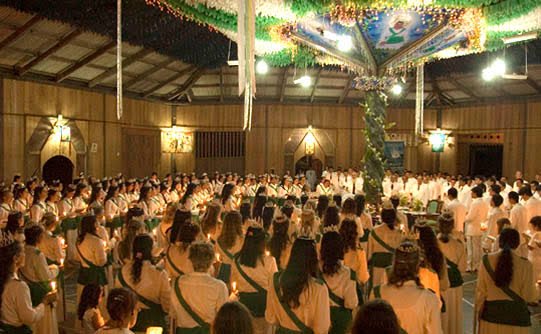
Participants, dressed in white, gather in round, thatched-roofed churches adorned with tapestries and crystals, engaging in hymns and meditation. The hallucinogenic tea is consumed throughout the night, allowing members to reflect on their lives and seek spiritual enlightenment.
Challenges and Controversies
Despite its spiritual focus, the Santo Daime Church faces challenges related to its conservative views on gender and sexuality.
Attitudes towards women and LGBTQ+ rights vary across different branches of the religion, often reflecting broader societal norms in Brazil.
Reports of sexual misconduct and safety concerns have also cast a shadow over the ayahuasca community. In 2018, several cases of sexual abuse were reported at the Reino do Sol religious centre in São Paulo, highlighting the need for greater oversight and regulation.
Additionally, the deaths of Western tourists seeking ayahuasca experiences abroad have prompted calls for increased awareness and safety measures.
Scientific Exploration and Future Prospects
Amidst the controversies, scientific research into ayahuasca’s potential benefits continues to grow.
A 2018 clinical trial conducted by Brazilian scientists at the Federal University of Rio Grande do Norte found that ayahuasca could be effective in treating severe depression.
This study contributes to a broader body of evidence suggesting that psychedelics, when used appropriately, can have transformative effects on mental health.
Organizations like the Chacruna Institute are working to bridge the gap between traditional ceremonial use and scientific research, advocating for the recognition of ayahuasca as an “immaterial cultural heritage” of Brazil.
As the conversation around ayahuasca evolves, the question remains whether the Brazilian government will choose to support or suppress this ancient practice.
“Exact numbers are difficult to obtain as most cases never come to light, but the issue [of sexual abuse] is common knowledge within the ayahuasca community.”
“Exact numbers are difficult to obtain as most cases never come to light, but the issue [of sexual abuse] is common knowledge within the ayahuasca community.”
“Exact numbers are difficult to obtain as most cases never come to light, but the issue [of sexual abuse] is common knowledge within the ayahuasca community.”
Fonte: newhumanist.org.uk