
The Mystical Depths of the Torah
The Torah, the sacred text of Judaism, is not just a collection of stories and laws. Its format is impressive: two large scrolls of parchment, handwritten with special ink, mounted on wooden spools, and adorned with embroidered cloth and silver ornaments. This sacred text, revealed by God to Moses on Mount Sinai, contains the first five books of the Bible, chronicling events from the Creation to the journey of the Israelites through the desert in search of the Promised Land. However, the richness of the Torah goes beyond its narrative.
According to Kabbalah, the Jewish mystical tradition, the 304,805 Hebrew letters of the Torah hold hidden meanings about God and the laws of the Universe. By using numerical keys and meditations, Kabbalists unlock these mysteries and derive lessons from the stories narrated in the text. Remarkably, one does not need to be a rabbi or even Jewish to access these teachings and apply them to improve one’s life.
The Origins and Evolution of Kabbalah
The secret of Kabbalah lies in the specific relationship between words and numbers in the Torah. Its origins can be traced back to the Sefer Yetzirah, or the Book of Creation, a small work whose authorship and date remain unknown. This book introduces the idea that God created the Universe using the 22 letters of the Hebrew alphabet. As researcher Daniel C. Matt explains in ‘The Essential Kabbalah’, the Book of Genesis already stated that the divine word was the instrument of Creation: God said, ‘Let there be light’, and there was light. The novelty of the Sefer Yetzirah is its speculation on how God combined these letters.
The book also presents the concept of the sefirot, which can mean ‘realm’, ‘sphere’, or ‘counting’, depending on the translation. Represented by the numbers 1 to 10, they are considered another instrument of the Universe’s creation. However, the Sefer Yetzirah did not explain how to use these concepts to reveal the Torah’s hidden meanings.
It wasn’t until the 13th century that the Spanish mystic Moses de León published the Sefer Ha Zohar, or the Book of Splendor, which consolidated what we now know as Kabbalah. This work connected each sefira to a mode of divine action and a biblical character. For instance, the sefira of Chessed is associated with love and Abraham. When Kabbalists read about Abraham in the Torah, they also perceive this merciful aspect of God acting in the world.
Unveiling the Secrets Through Numerology
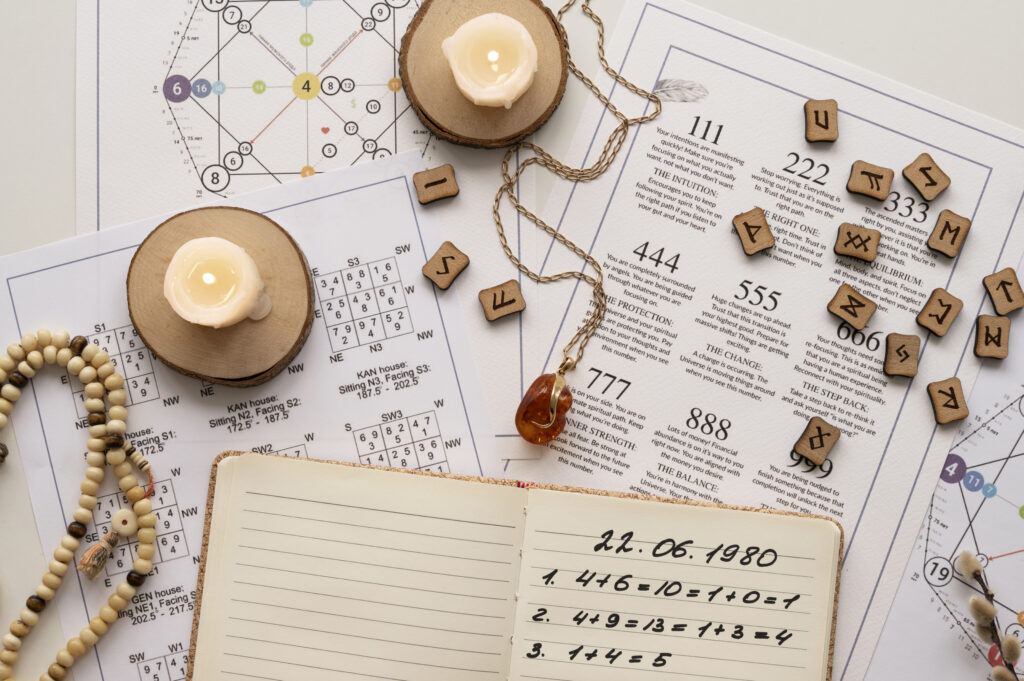
Kabbalists interpret the Torah using gematria, Jewish numerology. Each of the 22 Hebrew letters, from aleph to tav, has a numerical value. The first nine letters correspond to units (1, 2, 3, …, 9); the next nine to tens (10, 20, 30, …, 90); and the last four to hundreds (100, 200, 300, 400). By calculating these values, hidden meanings emerge that expand the sacred text’s teachings.
The stories in the Torah may seem unrelated to daily life, but Kabbalah reveals profound lessons about dealing with others and facing situations. For example, the biblical commandment ‘Thou shalt not kill’ seems contradictory when God orders the Israelites to kill the people of Amalek. However, using the Zohar’s calculations, the Hebrew letters of ‘Amalek’ have the same numerical value as ‘safek’, meaning ‘doubt’ or ‘uncertainty’. Thus, Kabbalah interprets this as a call to eliminate doubt and uncertainty within ourselves, rather than an external enemy.
Kabbalah’s Path to Personal Growth
Ancient Kabbalists used this wisdom to become better individuals and grow spiritually. Modern Kabbalists share this goal, aiming to understand more about God and derive life lessons to guide others. Contrary to popular belief, Jewish mysticism is not an oracle for discovering past or future events. Occasionally, someone might attempt to predict the Messiah’s arrival, but such endeavors invariably fail.
Historically, access to Kabbalah was restricted. Candidates had to be Jewish men over 40, and only the most spiritually qualified were accepted. Rabbis feared that the techniques might fall into unprepared hands. In many religions, mystical insights from laypeople have often been sources of risk and heresy. Even today, Orthodox Jews limit Kabbalah’s teaching. However, some more progressive branches disagree, believing that modern advancements allow for a broader understanding of these teachings.
The Modern Appeal of Kabbalah
The study of Kabbalah remained obscure for centuries, even among Jews, until it gained relative popularity in the 1990s. The Kabbalah Centre in the United States opened Kabbalah’s doors to laypeople of any religion. Celebrities like Madonna, who frequents the center, claim to have attracted positive energy since starting the course. Orthodox critics label this approach as ‘pop’ or ‘light’ Kabbalah, but the Kabbalah Centre insists that the knowledge is authentic, using the same texts as traditional Jewish sources.
According to Samuel Lemle, a Kabbalah Centre instructor, studying Kabbalah first provides a new attitude towards life. Just as there are physical laws like gravity, Kabbalah teaches that spiritual laws govern the world. It encourages living in harmony with these laws, emphasizing the principle of cause and effect over chance. Everything in life is a result of our actions. Thus, the most important lesson for beginners is to shift from a reactive to a proactive mindset, becoming the cause rather than the effect of situations.
Practical Applications of Kabbalistic Teachings
Being proactive means abandoning the victim role, which lacks control over situations. It involves pausing, reflecting, and choosing the best course of action in each moment. This approach applies to everyday scenarios, such as sibling conversations or marital disputes. Ancient Kabbalists like Abraham also taught proactivity, emphasizing a single Creator and a cause-and-effect law as a way to approach life.
In pursuit of this new attitude, students learn to use Kabbalistic tools. Simple combinations of letters, like ABD, serve as mantras for meditation. The Zohar explains that the eyes are the soul’s windows. Daily visualizing these letter sequences aids spiritual transformation, nourishing the soul to foster proactivity.
Of course, attending a few classes won’t instantly change one’s life. Like studying quantum physics, understanding Kabbalah deeply requires years of learning, starting with the basics. Even the initial lessons offer practical benefits, such as better emotional control in daily life. However, true progress depends on a genuine intention to learn and become a better person.
Kabbalah teaches us to eliminate doubt and uncertainty within ourselves, rather than battling external enemies.
| Hebrew Letter | Numerical Value |
|---|---|
| Aleph | 1 |
| Bet | 2 |
| Gimel | 3 |
| Dalet | 4 |
| He | 5 |
| Vav | 6 |
| Zayin | 7 |
| Chet | 8 |
| Tet | 9 |
| Yod | 10 |
| Kaf | 20 |
| Lamed | 30 |
| Mem | 40 |
| Nun | 50 |
| Samekh | 60 |
| Ayin | 70 |
| Pe | 80 |
| Tsade | 90 |
| Qof | 100 |
| Resh | 200 |
| Shin | 300 |
| Tav | 400 |
Fonte: super.abril.com.https://super.abril.com.br/br